
Close your eyes and listen to the crisp, sharp snap of a freshly cut cedar plank. Can you smell that? It is the scent of raw potential mixed with a hint of forest floor. When we talk about Natural Wood Block Puzzles, we are not just discussing toys; we are manipulating cellular structures to create tactile heirlooms. The wood grain is essentially a series of microscopic straws held together by lignin, and our job is to navigate those fibers without causing a catastrophic split. You want that buttery smooth finish that feels warm to the touch, a phenomenon caused by the low thermal conductivity of organic timber. We are going to take a raw, rugged block and transform it into a geometric masterpiece. It is all about the resistance of the blade against the density of the rings. Every cut is a conversation between your tool and the history of the tree. Let us get our hands dirty and our minds sharp because we are about to master the physics of play.
THE STUDIO KIT
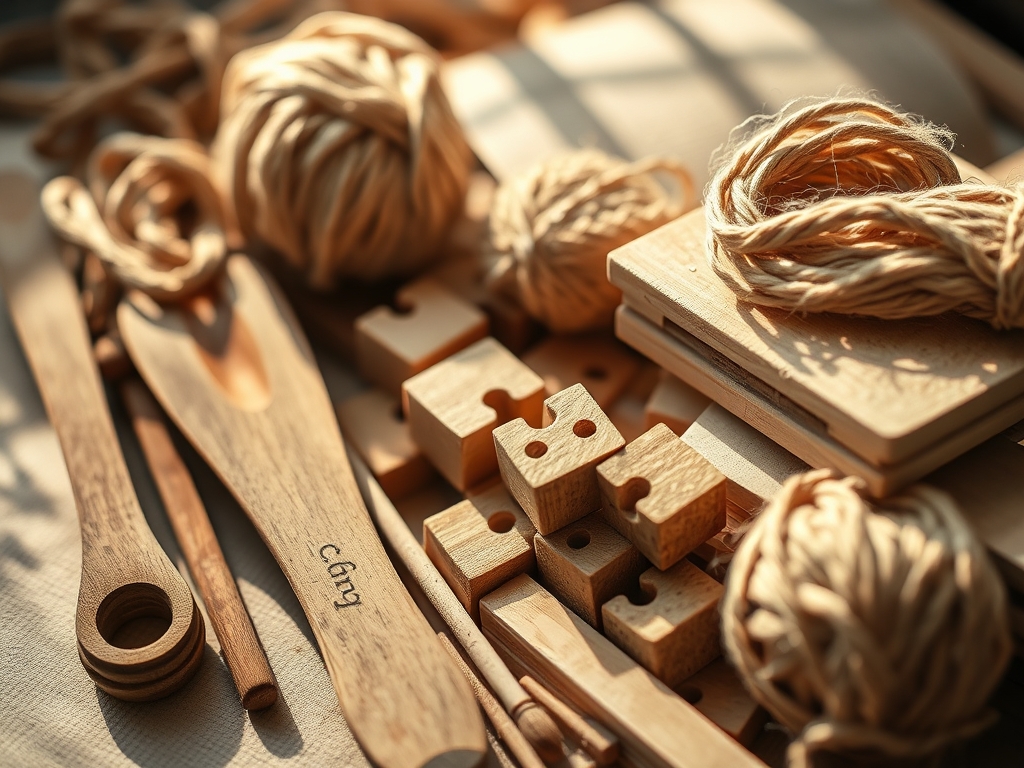
To execute these Natural Wood Block Puzzles with professional precision, your workbench needs more than just a basic saw. We start with digital calipers to ensure every dimension is accurate to the millimeter; uniformity is the secret to a puzzle that actually fits. You will need a Japanese pull saw (Ryoba) because its thin kerf removes less material, preserving the structural integrity of the wood. For the fine details, a jeweler's saw or a high-quality oscillating tool provides the control needed for intricate internal radii.
Your material selection is the foundation of the project. Choose hardwoods like maple or cherry for their high tensile strength and tight grain patterns, which prevent splintering during high-speed sanding. If you are looking for Material Substitutions, consider high-density birch plywood for a layered aesthetic, or reclaimed oak for a more rustic, porous texture. Do not forget a bone folder or a smooth stone to burnish the edges after sanding. This compresses the surface fibers, making them more resistant to moisture and oils from little hands. Finally, keep an awl handy for marking your pilot holes; it prevents the drill bit from wandering across the grain.
THE TEMPO
The "Maker's Rhythm" is a psychological state where your movements become fluid and your timing is impeccable. For this project, expect a total active time of about four hours, split into distinct phases of intensity. The Drafting Phase takes thirty minutes; this is where you map your geometry and account for the kerf loss (the width of the saw blade). The Cutting Phase is the most demanding, requiring roughly ninety minutes of high-focus mechanical work.
The Refinement Phase is where the magic happens. Spend sixty minutes on progressive sanding, moving from 80-grit to 400-grit sandpaper. This gradual transition is necessary to remove the microscopic "fuzz" or lignin whiskers that rise when wood is cut. The final hour is dedicated to the Curing Phase, where you apply a food-safe oil finish. The wood will absorb the oil through capillary action, a process that cannot be rushed. Allow the blocks to sit undisturbed so the finish can polymerize and create a durable, protective barrier.
THE CORE METHOD
1. The Longitudinal Split
The first move is a straight vertical cut along the grain. This is the simplest way to divide your block while respecting the natural orientation of the wood fibers. By cutting parallel to the tracheids, you minimize the risk of the wood checking or cracking over time. Use your pull saw with a steady, even stroke to maintain a perfectly flat face.
Mastery Tip: Always account for anisotropic expansion. Wood expands more across the grain than along it, so leave a fraction of a millimeter of "breathing room" between pieces to ensure they do not jam during humid months.
2. The Transverse Cross-Cut
This cut runs perpendicular to the grain, slicing through the "straws" of the wood. It requires a higher tooth-per-inch (TPI) blade to prevent "tear-out" on the back side of the block. This cut creates the flat ends that allow your Natural Wood Block Puzzles to stand upright.
Mastery Tip: To prevent splintering, apply a strip of painter's tape over the cut line. This provides lateral support to the surface fibers, keeping the edge crisp as the blade exits the wood.
3. The 45-Degree Miter
Miters add geometric complexity and visual interest. Using a miter box or a calibrated square, cut at a precise diagonal. This exposes the end grain in a decorative way, showcasing the growth rings of the tree. It is a classic move for creating interlocking "L" shapes.
Mastery Tip: The end grain is highly porous and will absorb more finish than the face grain. Sand this area to a higher grit than the rest of the block to "close" the pores and ensure an even color.
4. The Notched Dado
A dado is a groove cut into the face of the wood that allows another piece to slide in. This is the "lock" in your puzzle. Use an oscillating tool or a chisel to remove a precise rectangular section. The fit should be snug but not forced; we call this a "friction fit."
Mastery Tip: Use your calipers to measure the exact thickness of the mating piece. If the fit is too tight, the tensile stress could cause the wood to split along a weak grain line.
5. The Radiused Corner
Safety is paramount for children's toys, so every sharp corner must be transformed into a soft curve. Use a rasp or a coarse sanding block to create a consistent radius on every exposed edge. This is not just aesthetic; it increases the impact resistance of the block.
Mastery Tip: Use the "Fingertip Test" to check for mechanical burrs. If you feel any snagging, the wood fibers are still standing up. A quick burnish with a hard object will flatten them permanently.
THE TECHNICAL LEDGER
Maintenance & Longevity
Natural wood is a living material that reacts to its environment. To maintain your puzzles, wipe them down with a damp cloth and re-apply a beeswax or mineral oil finish every six months. This prevents the wood from becoming brittle and losing its luster. Avoid harsh chemicals that can break down the natural resins.
Material Variations
For a Sustainable approach, use bamboo, which has incredible compressive strength and grows rapidly. Premium options include walnut or mahogany for their deep hues and heavy weight. If you are using Recycled timber, ensure it is "clear" wood, meaning it is free of nails or old finishes that could contain lead.
The Correction
- The Gap: If your pieces are too loose, you can "swell" the wood by applying a tiny drop of water to the joint, though a permanent fix involves gluing a thin veneer shim to the face.
- The Binding: If pieces stick, the wood has likely expanded due to humidity. Sand the contact points lightly and apply a dry lubricant like paraffin wax.
- The Splinter: If a corner chips, do not discard it. Mix fine sawdust with wood glue to create a structural filler, pack it into the void, and sand smooth once cured.
Studio Organization
Store your finished blocks in a breathable cotton bag rather than airtight plastic. This allows for equilibrium moisture content (EMC) stabilization. Keep your tools organized by "Type of Force" (cutting, measuring, finishing) to streamline your workflow and prevent blade dulling.
THE FINAL REVEAL
Look at that! You have successfully navigated the complex world of timber physics to create something truly beautiful. These Natural Wood Block Puzzles are heavy, smooth, and resonate with a satisfying "clink" when they touch. You have mastered the art of the kerf, the science of the grain, and the patience of the cure. Your studio is now a place of high-level production, and your "bestie" is going to be absolutely floored by the professional quality of these pieces. They are not just blocks; they are a testament to your technical skill and creative spark.
STUDIO QUESTIONS
What is the best wood for beginners?
Maple is ideal because its tight grain and high density make it resistant to splintering. It is forgiving for those learning to control a saw while providing a professional, clean aesthetic that lasts for generations.
How do I make the blocks safe for toddlers?
Ensure you use a food-grade finish like raw linseed oil or beeswax. Sand every surface to at least 400-grit to eliminate "lignin whiskers" and use a large radius on all corners to prevent impact injuries.
Why do my puzzle pieces fit tightly sometimes and loosely others?
Wood is hygroscopic, meaning it absorbs moisture from the air. In high humidity, the fibers swell, tightening the fit. In dry conditions, they shrink. Always allow for a tiny "expansion gap" during the initial cutting phase.
Can I use a regular hand saw for this?
A standard carpenter's saw has a wide kerf and aggressive teeth, which can shred delicate puzzle pieces. A Japanese pull saw or a fine-tooth craft saw is much better for maintaining the precision required for interlocking joints.