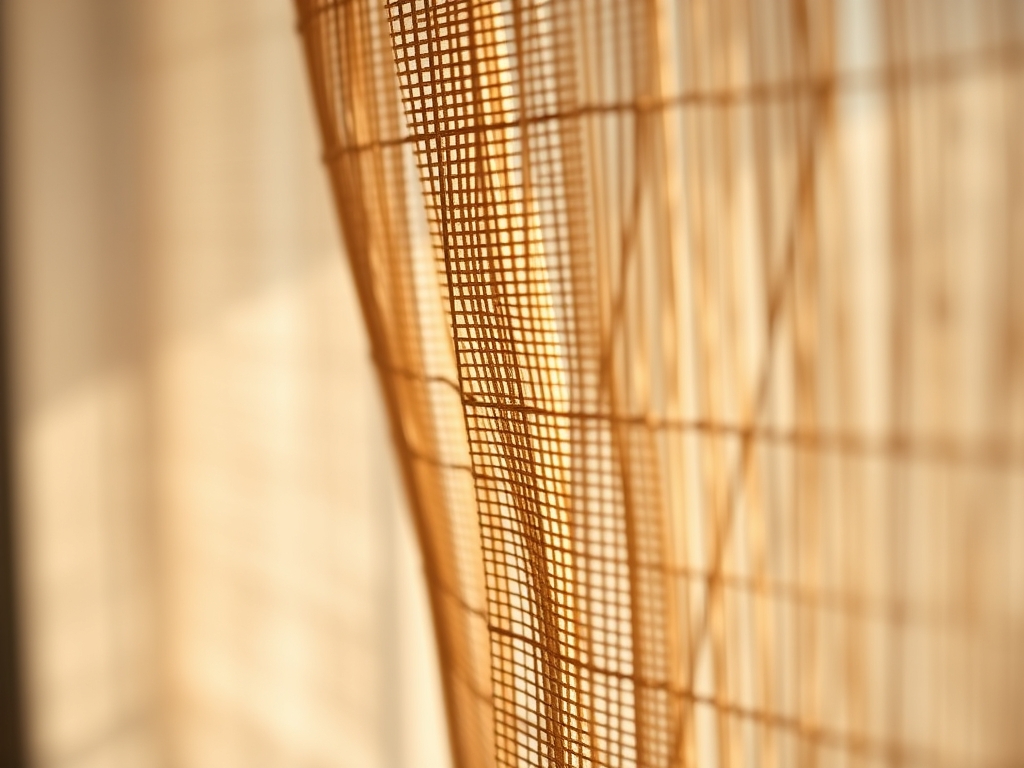
Run your fingers across the surface of a raw reed and you will feel the microscopic ridges of silica that give this grass its legendary strength. We are talking about the ultimate intersection of organic architecture and interior styling. When you install woven bamboo curtains, you are not just hanging a window treatment; you are deploying a sophisticated light filter that leverages the high tensile strength of woody fibers to create a private sanctuary. The smell is earthy, a mix of dried hay and sweet wood, signaling a material that is breathable yet incredibly resilient. These curtains act as a thermal barrier, using the hollow cellular structure of the bamboo culm to trap air and regulate room temperature. It is a tactile experience that shifts from the coarse grain of the outer husk to the smooth, burnished finish of a high quality weave. We are going to master the physics of these natural screens to ensure your home feels like a high end studio while keeping the prying eyes of the street firmly on the other side of the glass.
THE STUDIO KIT

To execute a professional installation, you need a kit that respects the material physics of the bamboo. You will need a digital caliper to measure the diameter of the individual slats; consistency in slat gauge determines how evenly the light will diffuse across the room. A heavy duty awl is essential for pre-drilling pilot holes in the headrail to prevent splitting the longitudinal grain. For the cordage, use a high-tenacity polyester pull cord with a braided core to resist fraying under constant friction.
If you are customizing the width, a fine-tooth Japanese pull saw is mandatory. The thin kerf of the blade ensures a clean cut without shattering the brittle vascular bundles of the bamboo. For material substitutions, if you cannot find authentic bamboo, look for jute or seagrass weaves. However, be aware that jute has a higher hygroscopic rate, meaning it absorbs more atmospheric moisture and may sag over time compared to the rigid structural integrity of bamboo. Always keep a bone folder handy to crisp up the folds if you are working with a Roman-style lift mechanism.
THE TEMPO
The "Maker's Rhythm" for this project is divided into three distinct phases: Calibration, Integration, and Tensioning. Calibration takes roughly thirty minutes; this is where you measure your window casing three times to account for any architectural subsidence. Integration is the physical mounting, which takes about one hour per window. This phase requires a steady hand to ensure the headrail is perfectly level, as even a two-degree tilt will cause the woven bamboo curtains to telescope and bind when raised.
The final phase, Tensioning, is the most meditative. You will spend twenty minutes per shade adjusting the cord locks and leveling the bottom rail. This is where you find the balance between gravity and mechanical lift. Do not rush the tensioning. The bamboo needs time to settle into its vertical hang, allowing the fibers to align under their own weight. Total time per window is approximately two hours, but the result is a lifetime of structural beauty.
THE CORE METHOD
1. The Perimeter Assessment
Before the first screw is driven, you must analyze the window jamb for structural soundness. Use your calipers to check the depth of the casing. Woven bamboo curtains require a specific clearance to allow the stacked material to fold without hitting the glass.
Mastery Tip: Understand thermal expansion. Natural fibers expand and contract with humidity. Leaving a 1/8-inch gap on either side prevents the shade from binding against the window frame during high-humidity months.
2. Pilot Hole Precision
Bamboo is a grass, not a hardwood, which means its fibers run strictly parallel. If you drive a screw directly into the headrail, you risk a catastrophic split along the entire length. Use your awl to mark the spot, then use a drill bit one size smaller than your screw.
Mastery Tip: This leverages cleavage resistance. By removing a small amount of material first, you reduce the outward pressure on the grain, ensuring the screw threads grip the fibers without shearing them apart.
3. The Leveling Logic
Mount the brackets using a bubble level or a laser level. If the brackets are not perfectly horizontal, the weight distribution of the bamboo will be uneven. This leads to "coning," where the shade rolls up like a scroll on one side.
Mastery Tip: This is basic gravitational equilibrium. An unlevel mount creates a lateral force component that pulls the weave out of its vertical plane, eventually damaging the outer warp threads.
4. Cord Path Calibration
Thread your lift cords through the rear rings. Ensure each cord follows a direct vertical path to the cord lock. Any deviation creates friction, which generates heat and prematurely wears down the fibers of the cord.
Mastery Tip: This involves kinetic friction coefficients. A straight path minimizes the energy required to lift the shade, protecting both the mechanical hardware and your own ergonomic effort.
5. Securing the Cleat
Install the cord cleat at a height that is both accessible and safe. The cleat is not just a hook; it is a safety device that manages the potential energy of the raised shade.
Mastery Tip: Use mechanical advantage. Wrapping the cord in a figure-eight pattern around the cleat uses friction to hold the weight of the bamboo, taking the stress off the plastic cord lock mechanism.
6. The Steam Set
Once the shade is hanging, use a handheld steamer to lightly mist the bamboo. This relaxes the fibers from their shipping tension and allows the curtain to find its natural "drop."
Mastery Tip: This utilizes hydroplasticity. Introducing controlled moisture and heat allows the cellulose fibers to rearrange slightly, removing any stubborn kinks or waves from the weaving process.
THE TECHNICAL LEDGER
Maintenance & Longevity: To keep your woven bamboo curtains in peak condition, use a vacuum with a soft brush attachment once a month. This prevents dust from settling into the porous grain. Avoid harsh chemical cleaners; a damp cloth with distilled water is all you need to preserve the natural resins.
Material Variations:
- Sustainable: Look for FSC-certified bamboo.
- Recycled: Some weaves incorporate recycled wood pulp or paper.
- Premium: Choose "tortoise shell" bamboo, which features natural mottled pigments and a higher density of silica for increased durability.
The Correction:
- Mistake: The shade hangs crooked. Fix: Adjust the cord length at the bottom rail by untying the knot and re-leveling the rail using a spirit level.
- Mistake: The bamboo is fraying at the edges. Fix: Apply a tiny amount of clear matte cyanoacrylate (super glue) to the end of the broken fiber to stop the run.
- Mistake: The cord lock won't catch. Fix: Check for "cord overlap" inside the mechanism; use a small screwdriver to realign the cords so they sit side-by-side.
Studio Organization: Store extra slats and cordage in a climate-controlled environment. Avoid garages or damp basements, as extreme temperature fluctuations can cause the bamboo to become brittle or develop mold in the porous vascular tubes.
THE FINAL REVEAL
Look at that transformation! The way the sunlight hits those woven bamboo curtains creates a rhythmic pattern of shadow and warmth across your floor. It is a total vibe shift. You have successfully merged ancient material science with modern interior aesthetics. The room feels grounded, private, and incredibly sophisticated. You didn't just buy a curtain; you engineered a light-filtering masterpiece that honors the natural world while protecting your personal space.
STUDIO QUESTIONS
How do you clean woven bamboo curtains?
Use a vacuum with a soft brush attachment to remove dust from the crevices. For spots, use a damp cloth with mild soap. Avoid soaking the bamboo, as excess water can cause the organic fibers to swell or develop mildew.
Can bamboo curtains be used outdoors?
Only if they are specifically rated for exterior use. Standard interior bamboo shades will degrade quickly when exposed to UV rays and direct rain. Look for "weather-resistant" versions that feature stainless steel hardware and UV-stabilized coatings to ensure longevity.
Do woven bamboo curtains provide total privacy?
They provide excellent daytime privacy while allowing filtered light in. At night, with interior lights on, silhouettes may be visible. For total "blackout" privacy, choose a version with a sewn-in fabric liner to block all light transmission and views.
How do I stop my bamboo shades from fraying?
Ensure the shades are not rubbing against the window trim. If you notice a loose fiber, trim it with sharp shears and seal the tip with a small drop of clear adhesive. This prevents the weave from unravelling further.